In June, 2001 I had the opportunity to address a IC2 Fellow special session, held in Lisbon. IC2 Institute, based on University of Texas in Austin, is an interdisciplinary research unit that the has advanced the theory and practice of entrepreneurial wealth creation (IC2 stands for Innovation, Creativity and Capital). IC2 institute has been founded in 1977 by Dr. George Kozmetsky (1917-2003).
This Lisbon meeting was focused about a transatlantic dialogue: "Learning by comparing US and European experiences on Innovation and competence building". IC2 Fellows was a distinguished group of scholars, most of them north americans. In the previous years I had been involved with corporate business in Africa and I had the opportunity to visit different african countries. So I used the opportunity to make a plea for Africa, calling for "joint scholar (action) research about innovative policies in Africa".
The "Africa Renaissance" idea launched during the 90's (and strongly supported by Bill Clinton) was doing its way. But most of the americans were (still are) very much ignorant about Africa - not only ignorant, but usually also afraid. I tried to arise their interest about Africa using some tales of my personal experience in Mozambique and Guinea-Bissao. Then I introduced a strange country in Africa, a peaceful and stable democracy with very positive results in education and health, in contrast with the everywhere drama of slow or negative growth and lower life expectancy in most of Africa during the 80's and 90's: Cape Verde.
Slides here
Friday, March 13, 2026


Tuesday, October 22, 2013
Announcing my translation of PERSONAL KNOWLEDGE, by Michael Polanyi
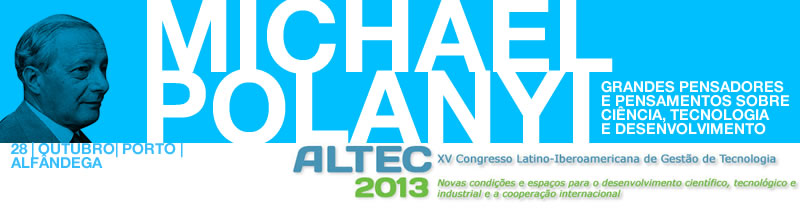

Presentation of this translation will happen during next specialized workshop of ALTEC 2013 congress. This is the first event of a new series of meetings about "Great thinkers and thoughts: science, technology and development". It will happen next 28 October, in the building of Alfandega of Porto, from 11:00 to 13:00. For more information about the program of this meeting and the new cycle, see here. Although this specialized workshop is part of ALTEC Congress, attendance fo this session is free (but free registration in the entrance will be needed).
To translate this great work of philosophy was for me a great intellectual adventure and personal discovery, that fully absorbed me for one year. As I said in the introductory note I have written for this edition
- Just as Polanyi theorized about the process of intimation for discovery, I discovered the intimation of Polanyi's thought: the discovery is a leap, struggling and risky, sometimes even conflicting, which creates a new meaning. Nobody stays the same after knowing something, after a process of discovery. Of course this work of translation and discovery also transformed me.
- Understanding innovation involves understanding the mechanisms of social and personal discovery in science and technology - innovation is not a technological issue, but a social issue with major economic implications. This was the key message in this course, so no wonder the contributions of Michael Polanyi to understand the processes of discovery and innovation were relevant and they have attracted my interest. The same motivation led us to organize an anthology of essays by M. Polanyi about science and technology (whose translation is now being published). This also helped to convince us to get down to this work: to translate the most important work of Polanyi.
This printing is an academic edition. A commercial edition will be available very soon. Meanwhile, chapters of the book are available here, for academic purposes.
Friday, August 2, 2013
Incremental innovation by Google: increasing power by new gmail changes
1. Apparently, a small change. Gmail inbox messages are now automatically allocated to three default tabs: promotions, social (from social networks, including google+) and primary (all the remaining messages: the most import ones for most of the professional people).
My own experience: great! And fewer concerns about opening non primary messages - including the promotional ones. I may get a look at the titles, but very rarely open anyone of them. Digital life quality has improved ... due to an (apparently) small change.
2. This is a typical incremental innovation by Google, that has implications for near half a billion of gmail users. Google basics is a disruptive innovation that gave Google a unique competitive advantage: free use for all, kindly paid by advertisers. I have discussed Google innovation in a recent paper (see here, chapters 5 and 6).
But sustainability of Google depends on a continuous flow of incremental innovations, not of a new radical changes. Small changes with impacts on millions of users. These are technological changes: technology changes when the object changes (the new gmail tabs), the way you use the object changes and consequently the "community of believers" do change. The change is positive when the "community of believers" increase in numbers or satisfaction, meaning additional value for users.
This gmail technology change is typical of all these changes.

- The key takeaway here is that the people that matter the most to email marketers won’t read less email now. In fact, it’s likely they’ll read more.
- Marketers may see a decline in engagement from less active subscribers, and if this group still drives a lot of revenue and conversions, then it’s likely marketers may have cause for concern.
- What is clear, however, is that Gmail, which has more than 425m active users around the world, is evolving constantly and marketers will need to adapt their strategies to keep up.
Thursday, February 7, 2013
Post modern information systems

This is not the first time I find interesting materials in Michael Schrage blog, from MIT. His recent post "Invest in Digital Marketing to Control Your Destiny" (here) has very challenging material about last US elections (for president) and the role of innovative and integrated IT analytics and procedures, a case that he sees as inspiring for all business operations:
- The Obama campaign's techniques, tools and technologies deserve detailed and dedicated attention from every organization that takes data-driven decisions seriously
- As campaigner-in-chief, however, this President is demonstrably without peer. His "Obama for America" fundraising, analytics and "get out the vote" operation was a masterpiece of agile electoral innovation and entrepreneurship. Partisans from both sides of the aisle believe it transformed presidential politics.
- Until the actual "Obama for America" codebase is freely available (and this is the subject of intense debate), if you want a blueprint, map or resource for your own organization's digital marketing aspirations, read, reread and then circulate Inside the Cave. It will provoke the internal conversation and debate your business likely needs.
Obama digital operation was a typical results oriented mission with limited time duration. Schrage comments that it is ironic that "top-tier politics has now become more innovative than top-tier business with these media & analytics", in a reply to a previous comment (by Doris Clark):

Marketing data is basically exogenous to the organization. For a long time collecting marketing data has been an expensive nightmare, and its integration in business information systems - largely based on data endogenous to the organization - has been even more difficult. "Inside the Cave" gives a fascinating insight in the integration of data collected from external sources now available in (near) real time and its use for decision making ("intelligent use of data to drive strategy). I would call it a "post modern" information system, post-PC and based on social networks.
- politics is the best testing ground for new strategies that can be applied to business. The singular focus on achieving a clear goal on a specific date (i.e., winning the election) provides very clear evidence of whether or not a given technique works.

Marketing data is basically exogenous to the organization. For a long time collecting marketing data has been an expensive nightmare, and its integration in business information systems - largely based on data endogenous to the organization - has been even more difficult. "Inside the Cave" gives a fascinating insight in the integration of data collected from external sources now available in (near) real time and its use for decision making ("intelligent use of data to drive strategy). I would call it a "post modern" information system, post-PC and based on social networks.


Sunday, September 9, 2012
Nuclear energy: fear, realism and panic
One of the last "The Saturday Essay" in WSJ was titled "The Panic Over Fukushima", by Richard Muller, professor of physics at the University of California, Berkeley. He discusses the potencial impact of the nuclear problems in Japan after the tsunami disaster. Its potencial mortality (two to fifteen hundred additional deaths in the next decades) is indeed a much smaller scale that the consequences (deaths) from earthquakes and tsunamis themselves, both frequent natural accidents in Japan:
(Italics our responsibility)
- it is remarkable how small the nuclear damage is compared with that of the earthquake and tsunami
- But the radiation deaths will likely be a number so small, compared with the tsunami deaths, that they should not be a central consideration in policy decisions
- It is remarkable that so much attention has been given to the radioactive release from Fukushima, considering that the direct death and destruction from the tsunami was enormously greater. Perhaps the reason for the focus on the reactor meltdown is that it is a solvable problem; in contrast, there is no plausible way to protect Japan from 50-foot tsunamis.
- Looking back more than a year after the event, it is clear that the Fukushima reactor complex, though nowhere close to state-of-the-art, was adequately designed to contain radiation. New reactors can be made even safer, of course, but the bottom line is that Fukushima passed the test.
- The great tragedy of the Fukushima accident is that Japan shut down all its politicals nuclear reactors. Even though officials have now turned two back on, the hardships and economic disruptions induced by this policy will be enormous and will dwarf any danger from the reactors themselves.
No technology is free from risks. But the risk of nuclear power seems to be smaller than the risk you accept when you board a plane, or you drive your car.
France resilience on nuclear energy looks the right option. Last decisions from Germany are purelly opportunistic about - expect them to be reversed in short to medium time.
(Italics our responsibility)
Monday, August 20, 2012
Experiments and scientific knowledge
In a previous post I have commented about Stephan Wolfram and A New Kind of Science. Here are a few citations from his very interesting post (A Moment for Particle Physics: The End of a 40-Year Story?) about the "particle of God" and all the media excitement about the recente CERN experiments (of course, part of the social battlefield seeking additional funding for the institution and its research program).
Some comments about the advanced (and expensive) research on physics of particles, based on his personal experience in this field:
Some comments about the advanced (and expensive) research on physics of particles, based on his personal experience in this field:
- But in the end—in a rather formative moment for my understanding of applying the scientific method—it turned out that what was wrong was actually the experiment, not the theory.
- Experiments are messy. Empirical evidence is not "clean" and direct: usually it is fuzzy and confusing. Polanyi had a clear understanding of this. The scientist commands the experiment (not the reverse).
- I suppose I had hoped for something qualitatively different from those particle physics talks I used to hear 40 years ago. Yes, the particle energies were larger, the detector was bigger, and the data rates were faster. But otherwise it seemed like nothing had changed (well, there also seemed to be a new predilection for statistical ideas like p values). There wasn’t even striking and memorable dynamic imagery of prized particle events, making use of all those modern visualization techniques that people like me have worked so hard to develop.
- Could future discoveries in particle physics immediately give us new inventions or technology? Years ago things like “quark bombs” seemed conceivable. But probably no more. Yes, one can use particle beams for their radiation effects. But I certainly wouldn’t expect to see anything like muonic computers, antiproton engines or neutrino tomography systems anytime soon. Of course, all that may change if somehow it’s figured out (and it doesn’t seem obviously impossible) how to miniaturize a particle accelerator.
- Over sufficiently long times, basic research has historically tended to be the very best investment one can make. And quite possibly particle physics will be no exception. But I rather expect that the great technological consequences of particle physics will rely more on the development of theory than on more results from experiment. If one figures out how to create energy from the vacuum or transmit information faster than light, it’ll surely be done by applying the theory in new and unexpected ways, rather than by using specific experiments
- But from my work on A New Kind of Science I developed a different intuition. That in fact there’s no reason all the richness we see in our universe couldn’t arise from some underlying rule—some underlying theory—that’s even quite simple
- Now of course it could be that something new will be discovered that makes it more obvious what the ultimate theory might look like. But my guess is that we don’t fundamentally need more experimental discoveries; we just need to spend more effort and be better at searching for the ultimate theory based on what we already know. And it’s certainly likely to be true that the human and computer resources necessary to take that search a long way will cost vastly less than actual experiments in particle accelerators.
Of course I appreciate very much the reference to Michael Polanyi. He correctly claimed that experimental results and empirical evidence do not make science and establish truth (although they contribute do it), but it is the consensus of the scientific community, in a certain moment, that defines what is accepted as scientific truth. This is not incompatible with Karl Popper falsibillity of scientific hypothesis. Although Popper has a very restrictive and limited view of scientific knowledge, and knowledge in general.
(Italics my resposability)
(Italics my resposability)
Monday, July 30, 2012
The euro is like a bumblebee. Why does it not flight any longer?
In this post (Here Bee Draghi) Krugman shows his skills as reader and observer, and also the non critical flock behaviour of journalists and media. From last speech by Mario Graghi, he choose the passage below, indeed a very interesting and significant one (that did not received significant attention from the press):
- The euro is like a bumblebee. This is a mystery of nature because it shouldn’t fly but instead it does. So the euro was a bumblebee that flew very well for several years. And now – and I think people ask “how come?” – probably there was something in the atmosphere, in the air, that made the bumblebee fly. Now something must have changed in the air, and we know what after the financial crisis. The bumblebee would have to graduate to a real bee. And that’s what it’s doing.
- The thing is, we know pretty well why the bumblebee was able to fly: massive capital flows from the core to the periphery, which led to an inflationary boom in said periphery, and which therefore also allowed the German economy — which was in the doldrums in the late 1990s — to experience a big gain in competitiveness and hence a surge in its trade surplus without needing to go through painful deflation. This meant, in turn, modest inflation in the eurozone as a whole — slightly above 2 percent over 1999-2007.
- To keep the thing flying, you’d need something like a reverse play along the same lines: an inflationary boom in Germany, so that the periphery can regain competitiveness without devastating deflation. And it would actually have to involve a higher rate of inflation, both because the required adjustment is bigger and because the periphery is a smaller share of euro area GDP, which by the math means that overall inflation needs to be higher to accommodate a given amount of relative adjustment.
But reality still seems far from this scenario.
Update, 30th July: Free Exchange, The Economist blog, deals with this "bumblebee" discourse in a post entitled When Draghi isn't everything. But it raises a "non technical" issue: what does it mean to save the euro - which euro has BCE a mandate to save? The present euro configuration or a a new geometry of countries (without Greece and may be others)?
Update, 30th July: Free Exchange, The Economist blog, deals with this "bumblebee" discourse in a post entitled When Draghi isn't everything. But it raises a "non technical" issue: what does it mean to save the euro - which euro has BCE a mandate to save? The present euro configuration or a a new geometry of countries (without Greece and may be others)?
- The ECB could take some of the pressure out of the crisis by pursuing an appropriate monetary policy: by acting more aggressively in order to push nominal output back to trend, even though that would mean higher inflation in Germany. But this is no longer the ECB's crisis to solve. It might have been, at one point. Political leaders, by acknowledging the real possibility of exits, have taken on full responsibility for whether and how the crisis is brought to an end.
- there always is a risk of reading too much in a central banker’s unavoidably cryptic statements
- First of all, Europe’s single currency is a deeply flawed construction. And Mr. Draghi, to his credit, actually acknowledged that. “The euro is like a bumblebee,” he declared.
- In the long run, the euro will be workable only if the European Union becomes much more like a unified country.
- Well, why was the bumblebee able to fly for a while? Why did the euro seem to work for its first eight or so years? Because the structure’s flaws were papered over by a boom in southern Europe.
- What could turn this dangerous situation around? The answer is fairly clear: policy makers would have to (a) do something to bring southern Europe’s borrowing costs down and (b) give Europe’s debtors the same kind of opportunity to export their way out of trouble that Germany received during the good years — that is, create a boom in Germany that mirrors the boom in southern Europe between 1999 and 2007. (And yes, that would mean a temporary rise in German inflation.) The trouble is that Europe’s policy makers seem reluctant to do (a) and completely unwilling to do (b).
- The euro can’t be saved unless Germany is also willing to accept substantially higher inflation over the next few years
- Should it be saved? Yes, even though its creation now looks like a huge mistake. For failure of the euro wouldn’t just cause economic disruption; it would be a giant blow to the wider European project, which has brought peace and democracy to a continent with a tragic history.
(Italics our responsability)
- The euro could have been saved a long time ago, had the politicians agreed on who should pay what or on how much sovereignty to surrender. Rather than push forward, Mrs Merkel has waited, hoping that fiscal adjustment and structural reform will lead to economic growth in southern Europe and that the politicians could sort out their differences.
- The evidence, though, is that time is not on her side. Southern Europe’s economic rot is deepening and spreading north. Politics is turning rancid as the south succumbs to austerity fatigue and the north to rescue fatigue (see article). Populism only makes a grand bargain more elusive. For the moment, breaking up the euro would be riskier than fixing it. But unless Mrs Merkel presses ahead, the choice will be between an expensive break-up sooner and a really ruinous one later.
Wednesday, July 11, 2012
Germany reforms: reality and myths
WSJ this weekend interview is with previous german chancellor, the man that promoted the structural reforms in Germany, claimed to be the reason for the present well being of its economy. It makes interesting historic reading and it points to some lessons: see "Gerhard Schröder: The Man Who Rescued the German Economy".
Conclusions from the interview:
1. The structural reforms programs costed him his job - but they were embraced by his successor. This continuity of public policies between different governments is unfortunately not very much apprecited in meridional countries.
2. In the german case there was much more than austerity, lower taxes,and reform of labour laws. Schroder does not mention the differences in economic climate in europe and world at that time. The same reforms would have very different results in the present environment. But he makes an important statement about the importance of union and labour relationships in Germany - and these points have not been changed. "Agenda 2010" policies in Germany were not anti-union and anti-work policies:
- Mr. Schröder does note that Germany's present economic vigor isn't solely the result of Agenda 2010. Work-sharing programs are common in Germany. During the financial crisis, this has allowed employers, with the help of government subsidies, to keep workers on reduced hours instead of laying them off. Mr. Schröder also notes that Germany's unique system of "co-determination," under which union representatives occupy permanent spots on corporate boards, ensures that labor and management are able to negotiate terms with both sides' long-term interests in mind.
- Aware of the political and historical sensitivities, Mr. Schröder counsels that Germany and the European Union shouldn't be encouraging Agenda 2010-style reforms as a cure for Southern Europe without concurrent measures to promote domestic spending and forestall immediate collapse. He echoes the suggestions of Mr. Hollande and others that the EU should invest in wobbling economies via the EU's regional development funds and project bonds for infrastructure. Too much pain without enough reward risks "destroying domestic demand," Mr. Schröder says. And even perfectly executed structural reforms will not yield results right away.
- His own attitude toward Greece is more sympathetic. ... He points to his own experience with Agenda 2010. In 2003, just as his reforms were beginning to be implemented, the European Commission deemed Germany and France to be in violation of the EU's deficit and debt ceilings. Mr. Schröder's finance minister at the time, Hans Eichel, proposed €20 billion (around $24 billion then) of additional spending cuts to put Germany in compliance with EU law.
- Mr. Schröder refused. "I said, 'Hans, that won't work. We can't push through these reforms, for which we need to devote all our power and take every risk, and also save €20 billion on top of that.'"
- That Germany and France were never punished for their debt transgressions is still seen as evidence that no EU rule is so important that the Continent's largest members cannot get around it. Many blame Berlin and Paris's original sin for, in effect, licensing the Mediterranean governments' borrowing sprees. But Mr. Schröder says that fiscal rules ought to be negotiable "in countries where structural reform is really taking place—where, if you like, an Agenda 2020 is being implemented."
Thursday, July 5, 2012
Innovative ideas in science: S. Wolfram and A NEW KIND OF SCIENCE

I remember when A New Kind of Science was published ten years ago (2002). It was a big, nice, strange, scandalous and very expensive book (the book is now freely available in the web). I became fascinated by the book - not only the content, but also the book itself. I remember to say in a conference at my University that it was the most well designed scholar book I had ever seen, not only with incredible images but also well organised, by levels of increasing depth and detail.
And it had a nice aroma and flavour of challenge to the classic scholar establishment (for instance, no list of references at the end of the book! and a very peculiar and challenging way to select and to present the citations included). He dare to present such a provocative, new and challenging contributions through publishing himself a book, not writing the classical papers to established peer reviewed journals. A book that is important by its own contributions is nowadays a very rare thing in the scientific community (in science and technology - not in social sciences, where the pattern in very different). "How did he dare to do it?": of course, it was the expected and natural reaction from the establishment.
Reading the book, it was easy for me to become fascinated by some of the ideas and to understand how good Stephen Wolfram is as a scholar - out of academy. To be a scholar outside the academy may be a nonsense for a lot of people (mostly in academy). Stephen is a rare case about what you can do when you do not have any need to pay homage to established people and ideas, you can work out of the box as you like (and you have plenty of resources - time and machines - to do it) and your career does not depend on it. And he is a member of the rare breed of scholars who simultaneously are entrepreneurs and top managers (Mathematica and related products talk by themselves).
Ten years later, NKN (as it is now known) is becoming a well recognised branch (methodology? framework?) of academic research and thought in very different fields, approaching simulation and modelling the real world outside the classical analytical framework of continuous physics and mathematics. The philosophical implications are still difficult to screen - but it is not difficult to anticipate some potential consequences.
Stephen Wolfram has now posted three nice and important post in his elegant blog. I very much recommend reading them. In the first one (It’s Been 10 Years: What’s Happened with A New Kind of Science?, 7th May) he reviews the first ten years of cellular automata and complexity related issues in the scholar literature during this first decade. In the second one (Living a Paradigm Shift: Looking Back on Reactions to A New Kind of Science, 11 May) he discusses a potential shift in paradigma and he discusses the reception to his ideas. In the third one (Looking to the Future of A New Kind of Science, 14 May) he speculates about future developments.
- A typical issue that came up was how the book was vetted or checked. In academia, there’s the idea that “peer review” is the ultimate method of checking anything. And perhaps in a world where everyone has infinite time, and nobody operates according to their own self-interest, this might be true. But in reality, peer review is fraught with error, often quite corrupt, and even in the best case strongly biased toward avoiding new ideas and maintaining the status quo. And for a piece of work as large, broad and complex as A New Kind of Science, even the basic mechanics of it seemed completely impractical.
- Today we are continually exposed to technology and engineering that is directly descended from the development of the mathematical approach to science that began in earnest three centuries ago. Sometime hence I believe a large portion of our technology will instead come from NKS ideas. It will not be created incrementally from components whose behavior we can analyze with traditional mathematics and related methods. Rather it will in effect be “mined” by searching the abstract computational universe of possible simple programs.
- And my key realization was that the computational universe of simple programs (such as cellular automata) provides an immensely rich source for such modeling. Traditional intuition would have led us to think that simple programs would always somehow have simple behavior. But my first crucial discovery was that this is not the case, and that in fact even remarkably simple programs can produce extremely complex behavior—that reproduces all sorts of phenomena we see in nature.

(Image: rule 101 of NKS book)
Wednesday, July 4, 2012
We had a dream ...

I. WE HAD A DREAM ...
It used to be an old dream: the union of european countries - an europe without wars, a land of peace.
My generation surprisingly had made it: one step after the other, a deeper union of the european countries has been built along the years, and its borders have enlarged. From the initial 6 western countries to the present 27 countries - including ex- communist eastern countries, something few people in 70's and 80's (and even first half of 90's) may have dreamed to see happening during his life. From the free mouvement of goods and people to the eurozone and Schengen space. Decades of prosperity and peace, seventy years after World War II and when the wars in Balkans seem to have been sorted out largely under the influence of EU.
The dream had become true, and it seemed to be working. Euro seemed a unique success. Peripheral countries, like Portugal, profited handsomely from joining the euro, in part due to low cost of sovereign debt. Debt was easier and peripheral countries did what they were expected to do: to accelerate the social and physical development of their people and land. Thanks god, the stock of infrastructures improved dramatically.
Until crisis arrived when a sudden and dramatic change in economic climate happened.
But not only changes in the economic climate. Meanwhile it was not only UE borders that have enlarged. Germany itself has changed: integration of eastern Germany took years and a lot of EU solidarity. Bur the after integration Germany is proving to be a different country with a different power balance and perspective: not only larger, but different. Its geostrategic positioning may be changing: more eastern oriented, less western friendly. New generations of political leaders emerged, with very different personal backgrounds and political culture.
Now these are hard times. Problems in the design of euro currency become visible in the present economic and financial environment. The north - south divide may be menacing EU unity, as well as euro - non euro divide. Some countries seem to be considering precautionary measures. May be Germany is or will consider exiting the euro (and EU?). Britain leaders seem to be positioning for the day after. And peripheral countries (including Portugal, Spain, Italy, Ireland and even Greece) may be paying un unfair price for the rigidities of a flawed euro currency, largely driven and leaded by Germany.
Now these are hard times. Problems in the design of euro currency become visible in the present economic and financial environment. The north - south divide may be menacing EU unity, as well as euro - non euro divide. Some countries seem to be considering precautionary measures. May be Germany is or will consider exiting the euro (and EU?). Britain leaders seem to be positioning for the day after. And peripheral countries (including Portugal, Spain, Italy, Ireland and even Greece) may be paying un unfair price for the rigidities of a flawed euro currency, largely driven and leaded by Germany.
Is this the end of the dream?
III A VOICE from Germany
Europe dream may be in danger. Did the spell turned against the sorcerer?
Last January, Joschka Fischer (German Foreign Minister and Vice Chancellor from 1998-2005) wrote that
We had a dream, and we have lived the dream. Too good to be true?
I hope we can still dream.
(Italics and bold, our responsability; Photo: embassy of Portugal in Paris, june 2011)
(Update, 5th July: Fischer has just published a new post in Project Syndicate, Europe's winners and loosers:
Yesterday a very grey leader, Durão Barroso, made a unusual strong and emotional speech in European Parliament. A note should be made. This looks like an important moment. Even NYT made a note of it:
- Mr. Barroso’s comments broke an atmosphere of optimism and relative calm that had prevailed after the summit meeting at the end of last week
Barroso recalled the ghost of war in europe in very clear words:
II. THE CRISIS as seen from America
In the same day Barroso was addressing European Parliament, Amartya Sen, from Harvard, and Nobel prize in economics, published a strong op-ed in The Guardian titled "Austerity is undermining Europe's grand vision". Subtitle is clear: "Economic policy is triggering disaffection among nations – the very thing the pioneers of unity hoped to erase":
- "Those who know European history know how negative was the role of prejudice and the complex of superiority of one part of Europe over the other”
II. THE CRISIS as seen from America
In the same day Barroso was addressing European Parliament, Amartya Sen, from Harvard, and Nobel prize in economics, published a strong op-ed in The Guardian titled "Austerity is undermining Europe's grand vision". Subtitle is clear: "Economic policy is triggering disaffection among nations – the very thing the pioneers of unity hoped to erase":
- The problems we are seeing in Europe today are mainly the result of policy mistakes: punishments for bad sequencing (currency unity first, political unity later); for bad economic reasoning (including ignoring Keynesian economic lessons as well as neglecting the importance of public services to European people); for authoritarian decision-making; and for persistent intellectual confusion between reform and austerity. Nothing in Europe is as important today as a clear-headed recognition of what has gone so badly wrong in implementing the grand vision of a united Europe.
- Like an inmate on death row, the euro has received another last-minute stay of execution. It will survive a little longer.
- It is deeply troubling that it took Europe’s leaders so long to see something so obvious (and evident more than a decade and half ago in the East Asia crisis). But what is missing from the agreement is even more significant than what is there.
- the remedies – far too little and too late – are based on a misdiagnosis of the problem and flawed economics.
- investment will decline – a vicious downward spiral on which Greece and Spain have already embarked. Germany seems surprised by this. Like medieval blood-letters, the country’s leaders refuse to see that the medicine does not work, and insist on more of it – until the patient finally dies.
- Indeed, it is remarkable that there has not been more capital flight. Europe’s leaders did not recognize this rising danger, which could easily be averted by a common guarantee, which would simultaneously correct the market distortion arising from the differential implicit subsidy.
- The euro was flawed from the outset, but it was clear that the consequences would become apparent only in a crisis. Politically and economically, it came with the best intentions.
- Europe’s temporizing approach to the crisis cannot work indefinitely. It is not just confidence in Europe’s periphery that is waning. The survival of the euro itself is being put in doubt.
III A VOICE from Germany
Europe dream may be in danger. Did the spell turned against the sorcerer?
Last January, Joschka Fischer (German Foreign Minister and Vice Chancellor from 1998-2005) wrote that
- If Merkel’s government believes that paying lip service to growth is enough, it is playing with fire: a euro collapse in which not only Germans would be badly burned.
- Indeed, rarely has Germany been as isolated as it is now. Hardly anyone understands our dogmatic austerity policy, which goes against all experience, and we are considered largely off-course, if not heading into oncoming traffic. It is still not too late to change direction, but now we have only days and weeks, perhaps months, rather than years.
- Germany destroyed itself – and the European order – twice in the twentieth century, and then convinced the West that it had drawn the right conclusions. Only in this manner – reflected most vividly in its embrace of the European project – did Germany win consent for its reunification. It would be both tragic and ironic if a restored Germany, by peaceful means and with the best of intentions, brought about the ruin of the European order a third time.
We had a dream, and we have lived the dream. Too good to be true?
I hope we can still dream.
(Italics and bold, our responsability; Photo: embassy of Portugal in Paris, june 2011)
(Update, 5th July: Fischer has just published a new post in Project Syndicate, Europe's winners and loosers:
- Both sides will have to decide whether or not they want Europe – that is, full economic and political integration. Economically, they must choose either joint liability and a transfer union or monetary re-nationalization. Politically, the choice is whether to empower a common government and parliament or return to full sovereignty. What we know for certain is that, just as one cannot be a little pregnant, the existing hybrid is not sustainable.)
(Update, 6th July: it seems that preliminary and maybe exploratory moves to test possible exits from euro common responsibilities are visible not only in Germany and UK, but also elsewhere: Finland seems to be now the case - even if claiming it otherwise. See Finland Would Rather Exit Euro Than Pay for Others, in WSJ. Finish finance minister has said:
- "Finland will not hang itself to the euro at any cost and we are prepared for all scenarios."
- "Collective responsibility for other countries' debt, economics and risks; this is not what we should be prepared for")
Monday, July 2, 2012
Can people trust banks management?

(Italics our responsability)
(Update, 5 July: article in The Economist, "The LIBOR affair: banksters":
- If attempts to manipulate LIBOR were successful—and the regulators think that Barclays did manage it, on occasion—then this would be the biggest securities fraud in history, affecting investors and borrowers around the world.)
Saturday, June 16, 2012
An extraordinary event: what does it mean?

John Gapper posts in FT Business Life blog ("How many other Rajat Guptas are out there?") that Gupta trial is an "extraordinary event", because of "his status at the apex of the business establishment". Remenber: Gupta ran McKinsey (at the age 45), was member of the board at Goldman and Sachs, and also Procter and Gamble. Few people can show such unusual and distinctive affiliations. Gupta has been a very top and influential man in american business, at the elite of the elite level.
His conviction is indeed important: he is someone whose wrong doings happened to have been accidentally tapped in dubious conversations when prosecutors were looking for wrong doing of a third party (his friend, and may be more than that, Raj Rajaratnam). A perfect case of american way of success in Wall Street and corporate environment happens to be found guilty of inside trading. The Economist Schumpeter blog titles a post "American dream turned nightmare" and "considers that the verdict provides a stunning denouement to Mr Gupta's career".
WSJ article on the case makes the point about motive:
- Mr. Gupta, 63 years old, once one of America's most-respected corporate directors, was motivated not by quick profits but rather a lifestyle where inside tips are the currency of friendships and elite business relationships.
- (this) is perhaps the most prominent defendant ever convicted of insider trading. While arbitrager Ivan Boesky was well-known at the time of his guilty plea in the 1980s, he wasn't as deeply embedded in American corporations as Mr. Gupta, who advised many high-profile chief executives. Junk-bond trader Michael Milken was indicted in an insider-trading investigation but pleaded guilty to other charges. Martha Stewart was also probed for insider trading but convicted of obstructing justice.
- So how many other board members of S&P 500 companies are out there, talking as openly about confidential information as Gupta? It seems improbable that he was the only one.
- The case will send a shudder through the upper echelons of the business and financial world. The risk of being caught on tape in the US leaking information improperly is now significant – loose lips endanger board directors.
(Italics my responsibility; network diagram from WSJ (here) )
(Update, 18th june: FT comments here about the impact of the case on McKinsey)
Thursday, May 31, 2012
From invention to innovation

BusinessWeek site, sorry - now Bloomberg BusinessWeek, has a nice slideshow about technology: Technology forgotten pioneers, by Vanessa Wong (24 May 2012). Forgotten inventors include people who invented:
- remote control for TV (and others)
- computer mouse
- telephone
- television
- windshield wipers
- light bulbs
- flying machines
We have a lot to learn from these cases. Some of their legal battles deserve admiration for the persistence. The windshield wipers is one of my favorites.
Wednesday, May 30, 2012
Europe: lessons from Japan
In my other blog (in portuguese), I have recently (19th April) posted a note about the japonese experience during last two decades and its potential lessons for the eurocrisis, based on the ideas of Richard Koo in his paper "Revitalizing the eurozone without fiscal union" to last INET Conference (Berlin, April 2012).
Today Krugman posted about Japan as "role model" and shows a plot of male employment rate, 15 to 64 years old, of Japan and USA from 1991 (only males in order to avoid eventual cultural bias). And he concludes that Japan has managed a "liquidity trap" situation much better than USA, avoiding a rise in unemployment under those adverse conditions:


Today Krugman posted about Japan as "role model" and shows a plot of male employment rate, 15 to 64 years old, of Japan and USA from 1991 (only males in order to avoid eventual cultural bias). And he concludes that Japan has managed a "liquidity trap" situation much better than USA, avoiding a rise in unemployment under those adverse conditions:
- For all its woes, Japan has never experienced the kind of employment collapse we’ve suffered. That’s the sense in which we’re doing far worse than the Japanese ever did.

Krugman post links to a nice piece of journalism: an interview of Krugman by Martin Wolf, published in weekend FT supplement (Lunch with FT: Krugman). In the interview Krugman has commented about the japonese experience:
- “What we thought was that Japan was a cautionary tale. It has turned into Japan as almost a role model. They never had as big a slump as we have had. They managed to have growing per capita income through most of what we call their ‘lost decade’. My running joke is that the group of us who were worried about Japan a dozen years ago ought to go to Tokyo and apologise to the emperor. We’ve done worse than they ever did. When people ask: might we become Japan? I say: I wish we could become Japan.”
Next figure compares Germany data with the southern countries in crisis (Portugal, Spain, Italy and Greece). Post 2008 crisis data for the four southern countries show a dramatic drop in male employment rate - softer in Italy but very hard for the other three countries. These lines show how the gap in economic environments between these countries and Germany is enlarging very fast, which may transform the situation into a very difficult one. The ghost of the Prussian may happen to return to Europe. (El Pais, the spanish newspaper, publishes today an article about the new Cold EuroWar with the division of UE into two different blocs).

More from Krugman interview to Martin Wolf, about the eurocrisis:
- “No. I don’t think they can save Greece but they can still save the rest if they’re willing to offer open-ended financing and macroeconomic expansion.” But this would mean persuading the Germans to change their philosophy of economic life. “Well, the prospect of hanging concentrates the mind; the prospect of a collapse of the euro might concentrate their minds.”
- Would he conclude that the European currency union was a mistake? “Yes, I think we’ve been asking, whose fault is this crisis? And I think it was basically fated, from the day the Maastricht Treaty was signed. Now, I think it might be rescuable with a higher inflation target, which is a poor second best to having a fiscal union. But no, the setup is fundamentally not workable.“
- What’s interesting is that the euro itself created the asymmetric shocks that are now destroying it [via the capital flows it engendered]. Not only have they created something incapable of dealing with shocks but the creation engendered the shocks that are destroying it.”
Sources: data from OECD, Short term labour market statistics.
Sunday, May 20, 2012
Two other countries with different fates
Both countries have similar names, both are islands and both went burst due to bank problems after 2008 crisis: Iceland and Ireland.
Three years later, Iceland is performing much better and becomes a case of fast restructuring following huge banking losses (see WSJ article: In European Crisis, Iceland Emerges as an Island of Recovery). Here is the quarterly data for growth:

The weakness of Ireland versus Iceland recover is well shown by the continuous fall in private spending in Ireland, versus a continuous recovery of private spending in Iceland after mid 2010:

Medium term debt and deficit histories of both countries in next two figures:


Different fates in similar periods of time associated with different currency and policy environments for similar problems and histories. Once again, the same pattern as discussed in previous post.
Update, 30 May: the story from the employment rate point of view, a similar pattern:

Update, 30 May: the story from the employment rate point of view, a similar pattern:

(Source of data: OECD.StatExtracts)
(Update, 8 July: more about Ireland versus Iceland, in a post by Krugman:
(Update, 8 July: more about Ireland versus Iceland, in a post by Krugman:
- Iceland is a dramatic demonstration of the wrongness of conventional wisdom in these times. Ireland did everything it was supposed to; nobody would describe it as “healing”. Iceland broke all the rules, and things are not too bad.)
Subscribe to:
Comments (Atom)